Live classroom teaching
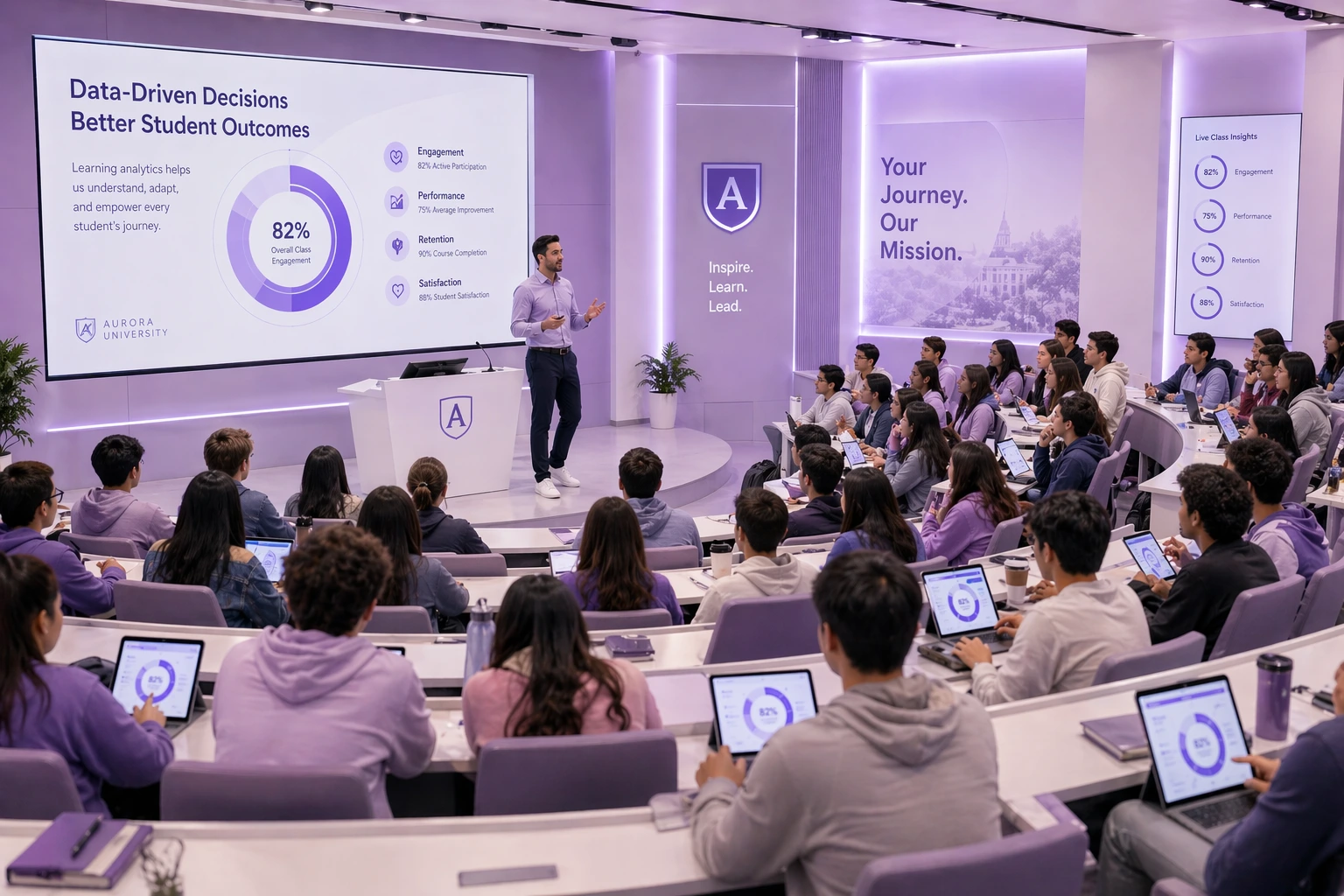
Faculty teach one agenda item at a time while students adjust a live multi-dimensional signal on their phones, making understanding visible before the class moves on.
Article focus
Academic use case
Structured for real rooms, visible dimensions, and clearer discussion.
Dimensions shown
4
Typical live lenses used to structure the room.
What improves
4
Core gains this setup tends to produce.
Why this use case matters
PulseRoom turns a lesson into a live reading of understanding. Instead of waiting for a quiz, a raised hand, or the end of class, the faculty member can see whether the room is grasping the concept, applying it, and connecting it to the wider decision context while the teaching is still happening.
This is especially powerful in concept-heavy classrooms where students often look engaged but are actually split between surface familiarity and real understanding. PulseRoom lets the teacher work one learning outcome at a time, keep the room active, and adapt in the moment.
What improves
Improves pacing because the instructor can see whether the class is ready to move on.
Gives quieter students a continuous and structured way to participate.
Makes learning multi-dimensional rather than reducing it to yes-or-no understanding.
Helps faculty distinguish weak explanation from weak application.
How the room moves
PulseRoom is most useful when the session has a clear rhythm: frame the topic, choose the dimensions, watch the signal evolve, and respond before the moment is lost.
Frame the learning outcome
Turn one agenda item into a question the room needs to answer or understand before the session moves on.
Choose 3 to 5 dimensions
Define the live lenses that matter for the topic such as clarity, application, judgment, evidence, or confidence.
Teach while the signal evolves
Students keep adjusting the radial graph on their phones as explanation, examples, and discussion unfold.
Adapt and deepen
The faculty member sees where the room is strong or weak and decides what needs more illustration, challenge, or simplification.
Example agenda items
Questions that give the room a clear purpose
Can we explain how operating leverage amplifies both upside and downside?
Can we distinguish strategy from execution in this case?
Can we identify the real bottleneck in this process rather than the visible symptom?
Typical dimensions
The lenses that shape the discussion
Room blueprint
Where this works best
Best used for one learning outcome at a time rather than an entire lecture block.
Works well in finance, operations, strategy, HR, marketing, governance, and executive education classrooms.
Most sessions are strongest with 3 or 4 dimensions, but 5 can work when the room is experienced and the topic has richer layers.
Deeper perspective
Why this use case becomes more useful in practice
Why it changes the classroom
A conventional lecture gives the teacher only weak signals. A few students speak, a few nod, and most of the room remains difficult to read. PulseRoom changes that by creating a live visual pattern of learning. The room no longer looks silent; it becomes legible.
That changes faculty behavior in a constructive way. Instead of teaching by assumption, the instructor teaches by visible movement: which dimension is rising, which one is flat, and where the room is still not convinced.
How students experience it
Students are not just rating the session. They are tracking their own learning against a visible set of dimensions. This makes participation more reflective and less performative because the task is not to speak for attention, but to signal honestly and adjust as understanding deepens.
As the session progresses, students begin to see that they may understand the concept but still struggle with application, or feel confident about the example but weak on interpretation. That self-awareness is a meaningful part of the learning value.
Where it works best
This use case is strongest in rooms where one question deserves a careful treatment rather than a quick poll. It works particularly well in case teaching, problem-solving sessions, executive classrooms, and seminars where discussion quality matters as much as content coverage.